Key Features & Benefits

Extensive Compatibility

  • Supports 450+ medical devices from various manufacturers.
  • Easily expandable for future device
    types.

Web-Based Management

  • Manage everything via the intuitive Picis Portal, Mini-PCs status, manage drivers, and export data easily.

The Picis Portal provides administrative control but does not display patient data collected by the Device Hub. The connected EMR/HIS handles clinical visibility.

Vendor Neutral & Interoperable

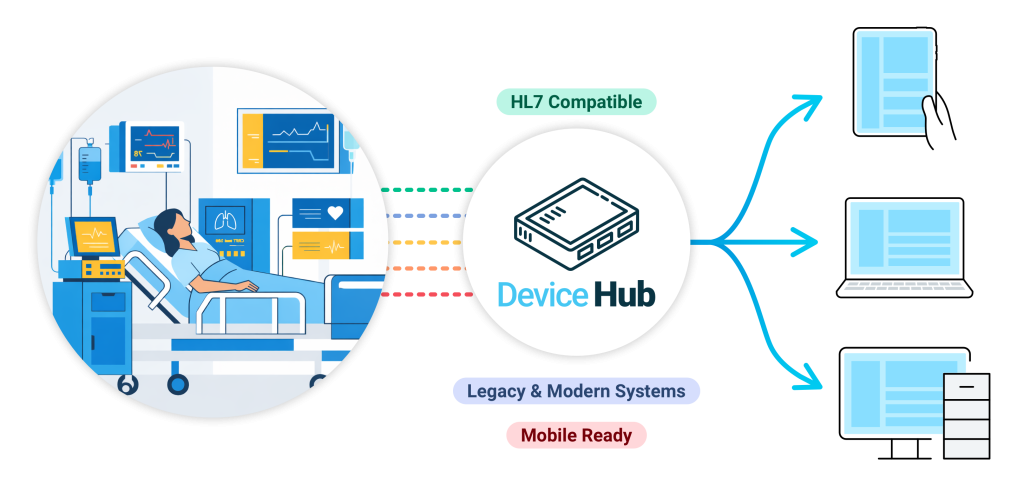
  • Connects with any system via HL7.

  • Compatible with all leading EMR/HIS solutions.

  • Supports both modern and legacy connections, including serial cable options, to ensure broad interoperability.

Cost-Effective Deployment

  • No need for proprietary hardware deployment on existing compatible setups.

  • Efficient architecture reduces total cost of ownership (TCO).

Streamlined Workflow

  • Reduce documentation time with automated data capture, which replaces manual entry and frees clinicians to focus on care.

Flexible Bed Management

  • Quickly reassign beds and bays without manually reconfiguring devices.
  • Streamlines operations in dynamic care environments.

Accurate, Near Real-Time Data

  • Captures consistent, error-free data directly from devices, enabling faster, better-informed clinical decisions.

Clutter-Free, Cable-Free Connectivit

  • Reduces serial cable clutter and the risk of disconnections.

Serial cable connectivity remains supported for legacy systems that require it.

  • Fewer physical connections improve infection control.

Mobile-Friendly Deployment

  • The Picis Portal works seamlessly on tablets and portable hardware, enabling configuration and management of Device Hubs on the go.

Please note: Access to patient data via mobile devices depends entirely on the EMR/HIS system integrated with the Device Hub, not the Hub or Portal directly.

Seamless Data Integration & Compliance

  • Wirelessly transmits critical data to EHRs in near real-time. (ia Wi-Fi supported Mini-PC)

  • Reduces delays and manual entry while supporting HIPAA compliance.

How It Works

How Device Hub Fits Into Your Workflow

Picis Device Hub collects data from bedside devices, standardizes it, and transmits it in near real-time to your clinical systems, ideal for ICUs, ORs, and more.

  • Supports standalone or integrated deployment
  • Captures vitals and infusion data in near real-time
  • Works in local or cloud environments
  • Virtualization-ready means the Device Hub software can be deployed in a virtualized environment (such as VMware or Hyper-V), allowing for flexible infrastructure planning and easier scaling without requiring dedicated physical hardware.

Video

Software-Driven Platform with Hardware Flexibility

  • Supports over 450 medical devices from multiple manufacturers

  • Compatible with ARM devices, virtual machines, and anesthesia machines

  • Serial, Ethernet, and USB compatible

  • Captures near real-time snapshots

  • HL7

  • Driver management and monitoring tools

  • Cloud-ready architecture

FAQ – Picis Device Hub

What is a medical device integration hub?

A medical device integration hub connects patient care devices, like monitors, ventilators, and infusion pumps, to a central system. It collects near real-time patient data and feeds it into EHRs or clinical systems. This reduces manual entry errors and improves workflow efficiency by automating data documentation.

A medical device integration hub connects patient care devices, like monitors, ventilators, and infusion pumps, to a central system. It collects near real-time patient data and feeds it into EHRs or clinical systems. This reduces manual entry errors and improves workflow efficiency by automating data documentation.

A medical device integration hub connects patient care devices, like monitors, ventilators, and infusion pumps, to a central system. It collects near real-time patient data and feeds it into EHRs or clinical systems. This reduces manual entry errors and improves workflow efficiency by automating data documentation.

A medical device integration hub connects patient care devices, like monitors, ventilators, and infusion pumps, to a central system. It collects near real-time patient data and feeds it into EHRs or clinical systems. This reduces manual entry errors and improves workflow efficiency by automating data documentation.

Ready To Deploy

Quick to Install
Easy to Scale
Simple to Manage