
Anesthesia has never been a stationary profession.
Clinicians assess patients before surgery, care for them throughout the procedure in the operating
room, respond as conditions change, and help guide the transition to recovery. Information follows
the patient throughout that journey, yet the technology used to document that care has often been
built around a fixed location.
That is the idea behind Picis Prima, a new mobile anesthesia documentation platform designed to
support anesthesia teams wherever care takes them.
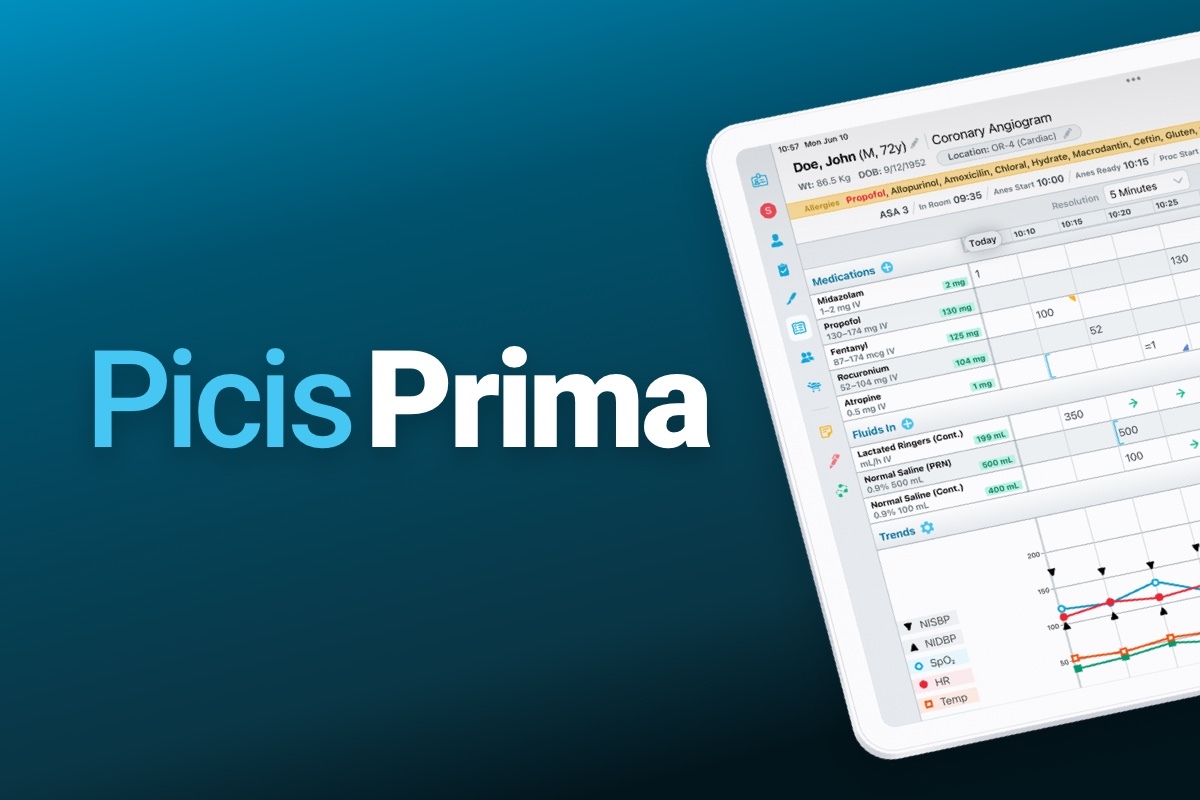
Prima brings anesthesia documentation to a connected tablet, giving clinicians greater flexibility to
access patient information and document care throughout their workflow. It supports the
anesthesia journey from preoperative assessment to intraoperative care, maintaining continuity
across the perioperative patient record.
This is not mobility for mobility’s sake. It reflects a much simpler question:
If care moves, why shouldn’t documentation move with it?
The Next Step in Anesthesia Documentation
Anesthesia documentation has changed significantly over the past several decades.
Paper records gave way to electronic documentation, and Anesthesia Information Management Systems (AIMS) have evolved from automated intraoperative recordkeeping systems into more sophisticated platforms integrated with the electronic health record and capable of supporting documentation across the perioperative experience.[1]
But moving documentation from paper to a computer did not solve every workflow challenge.
Research has shown that the design of anesthesia documentation technology matters. One observational study found that incomplete electronic anesthesia documentation was associated with reliance on free-text entry and with systems that did not present documentation elements in a logical sequence consistent with clinical workflow.[2]
Other research has demonstrated what can happen when documentation is deliberately designed around clinical context. One study of more than 12,000 anesthesia records reported 99.6% record completeness using context-sensitive mandatory data-entry fields, while users also rated the system’s usability highly.[3]
The lesson is important.
Good documentation technology should not simply capture information. It should fit the way clinicians work.
Prima takes that principle into a mobile environment.
What Is Prima?
Prima is a mobile clinical documentation platform built specifically for anesthesia and perioperative workflows.
From preoperative assessment through intraoperative care, Prima gives clinicians mobile access to the information and documentation tools that support the anesthesia workflow. This includes patient information, medications, physiological data, fluids, clinical notes, anesthesia times, assessments, and other elements of the anesthesia record.
Prima can also receive physiological information from appropriately connected patient monitors, ventilators, and anesthesia machines. HL7-based interoperability supports connected workflows with electronic medical records, helping maintain continuity of information across the perioperative journey.
The workstation still has a role.
Prima means it no longer must define the boundaries of where anesthesia documentation can happen.
Why Mobility Matters
Mobile technology is hardly new to healthcare. What matters is how it is used.
Meaningful mobility is not about taking software designed for a workstation and putting it onto a smaller screen. It is about reconsidering where work needs to happen and designing technology around that reality.
For anesthesia clinicians, that distinction is important. Mobile access creates opportunities to document information during the clinical workflow rather than relying as heavily on returning to a workstation or completing documentation later. When appropriately connected to medical devices, information can also flow directly into the anesthesia record, reducing the need for manual transcription.
The objective is not more documentation. It is documentation that fits more naturally into care.
Research into AIMS usability reinforces the importance of that distinction. In one usability study, a redesigned AIMS interface improved documentation accuracy from 85.1% to 92.4%, reduced the number of documentation steps, and decreased the number of user interactions required for certain tasks.[4]
The findings do not specifically evaluate mobile anesthesia documentation. Still, they reinforce a broader principle that matters when considering mobility: how clinicians interact with documentation technology can affect the documentation experience.
Anesthesia documentation should not have a fixed address.
Designed Around the Clinician
The most useful clinical technology often begins with a simple observation about how people actually work.
Anesthesia clinicians move between patients, clinical spaces, equipment, and responsibilities throughout the perioperative environment. Technology designed for that environment should recognize that reality.
Prima was built with mobility at its core, giving clinicians another way to interact with anesthesia information without disconnecting that information from the broader perioperative record.
“Prima is about giving anesthesia clinicians more freedom in how they document care. We wanted to create an experience that feels natural in a clinical environment where movement is already part of the workflow.”
Ashley Manlow, Director, Innovation & Product
That connectivity is important. Mobility should not create another information island.
Prima supports connected medical devices, physiological data capture, clinical documentation, and HL7 interoperability while maintaining continuity across the perioperative record. Mobile documentation becomes part of the clinical information environment, not separate from it.
A New Chapter for Anesthesia Documentation
For years, the evolution of anesthesia documentation was largely about replacing paper, capturing more information electronically, and connecting systems.
The next evolution may be less about where technology lives and more about where clinicians can use it.
Prima gives anesthesia teams greater freedom in how and where documentation fits into their workflow while keeping that information connected to the broader perioperative record.
That is an important distinction.
The goal of mobile anesthesia is not to put more technology between clinicians and patients. It is to make technology available in a way that better reflects how anesthesia care is actually delivered.
Care moves. Clinicians move. Anesthesia documentation should be able to move with them.
References
- Simpao AF, Rehman MA. Anesthesia Information Management Systems. Anesthesia & Analgesia. 2018;127(1):90–94.
https://pubmed.ncbi.nlm.nih.gov/29049075/ - Vigoda MM, Gencorelli F, Lubarsky DA. An observational study of anesthesia record completeness using an anesthesia information management system. Anesthesia & Analgesia. 2007.
https://pubmed.ncbi.nlm.nih.gov/17513641/ - Avidan A, Weissman C. Record completeness and data concordance in an anesthesia information management system using context-sensitive mandatory data-entry fields. 2012.
https://pubmed.ncbi.nlm.nih.gov/22244818/ - Wanderer JP, Rao AV, Rothwell SH, Ehrenfeld JM. Comparing two anesthesia information management system user interfaces: a usability evaluation. Canadian Journal of Anesthesia. 2012.
https://pubmed.ncbi.nlm.nih.gov/23055030/
Prima Product Information
Picis Clinical Solutions. Picis Prima: Mobile Anesthesia Documentation Designed for Perioperative Care.
https://www.picis.com/picisprima/